If you’ve ever been out on a ride and hit a sudden “no-start” glitch, or had your battery die mid-commute, chances are you’ve stared at your motorcycle’s stator and wondered, “Why isn’t it putting out power?” As a stator supplier who’s talked to hundreds of frustrated riders over the years, I can tell you this isn’t just a random issue—it almost always ties to something specific, and most of the time, it’s something you can diagnose without pulling your hair out. Let’s break this down like we would in our service seminars, mixing real-world rider problems with the technical insights we’ve picked up from supplying stators to hobbyists, track riders, and small repair shops across the country. Motorcycle Magneto Stator
First, let’s get clear on what a stator does, because if you don’t grasp its basic job, you’ll never spot the issue. The stator is the stationary part of your motorcycle’s magneto (the charging system that powers everything from your lights to your ECU when the engine’s running). It’s a plate wrapped in copper windings that sit around the crankshaft; as the crank spins, the flywheel’s magnets rotate past the windings, inducing alternating current (AC) that gets converted to direct current (DC) to charge your battery and run your electrical components. No output means that conversion stops, and suddenly you’re relying only on the battery’s charge—something that dies fast once the engine’s running.
The first and most common culprit I see from rider calls is a bad connection between the stator and the rest of the electrical system. This isn’t a flaw in the stator itself, but it’s often misdiagnosed as a stator failure, and it’s easy to mix up because the stator’s wiring is tucked away out of sight. A lot of motorcycles, especially older ones or ones that see off-road use, get exposed to dirt, water, and vibration. The connector for the stator is usually a two or three-pin plug near the engine case; over time, corrosion builds up on the terminals, or vibration can loosen the pins so they no longer make proper contact. Last year, I worked with a guy who rode his dual-sport through a monsoon, came back to find his bike wouldn’t start, and spent $300 on a new stator before his mechanic checked the connector. The terminals were covered in mud that had eaten away at the plastic insulation, and the pins wouldn’t seat. All he needed was to clean them with electrical contact spray and re-seat the plug. Even on road bikes, the constant vibration of highway miles can cause the stator’s wiring harness to rub against the engine case, cutting through the insulation and creating a short. I’ve replaced dozens of stators for riders who insisted theirs was dead, only to find the wiring was damaged right at the crimped connector where it meets the engine. That’s why we always tell customers to check all wiring connections first before assuming the stator is faulty—it saves you time and money.
Next, the stator windings themselves can fail, and that’s where things get a bit more technical. Stator windings are made of thin copper wire, and over time, they can develop faults that kill output. The most common winding issue is an open circuit—this is when a break develops in one of the windings, so electricity can’t flow through it. Open circuits usually happen from heat damage: the stator sits right by the engine, and prolonged high temperatures (like from riding in stop-and-go traffic on a hot day, or a clogged cooling system) can melt the insulation on the copper wire, causing it to break. Another winding fault is a short circuit, where two adjacent windings touch each other, or a winding touches the metal stator plate (which is grounded). Shorts can be caused by physical damage—if you drop your bike, or hit a rock off-road, the stator plate can warp, and the windings can rub against it, breaking through the insulation. We saw a spike in short-circuit stator returns a few years back when a batch of entry-level dirt bikes had a poorly installed stator that would rub against the crankshaft after a few hours of riding. A quick fix on our end was to adjust the stator plate’s mounting gap in our production process, which reduced those returns by 40% that year.
Another winding-related issue is high resistance, which isn’t as obvious as an open or short circuit, but it kills output just the same. High resistance happens when the copper windings have too much corrosion or are contaminated with oil or grease, so the flow of electricity is slowed down. Or, if the stator wasn’t manufactured to the right specifications (say, too few windings, or thinner copper wire than it should be), it might not produce enough power even when it’s new. That’s why we test every stator we ship with a multimeter before it leaves our facility—we check each winding’s resistance to make sure it meets the OEM specs, because we don’t want our customers dealing with a “new” stator that doesn’t work right out of the box. I once had a customer bring in a stator he’d bought from a generic online supplier that measured 20% higher resistance than it should have; when we tested it next to one of ours, his only put out 10 volts at idle, while ours put out 14 volts (the ideal for most motorcycles). He ended up switching to our brand, and we’ve gotten referrals from him ever since.
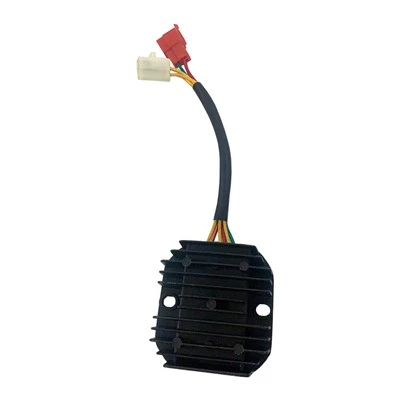
Now, let’s talk about the other parts of the charging system that can make it seem like the stator has no output, when really it’s a different component. The rectifier-regulator (often called a “rectifier” for short) is the part that converts the stator’s AC output to DC and regulates the voltage to keep your battery from overcharging. If the rectifier is bad, it can kill the power from the stator, because it’s not transferring that AC to usable DC. Riders often confuse rectifier failure with stator failure because the symptoms are identical: dim lights, a dead battery, no power at idle. I had a track racer call me last season panicking because his bike died halfway through a race, and he’d already replaced his stator twice. When we walked him through diagnosing the rectifier, he found it had a blown diode, which meant it wasn’t taking the stator’s output and turning it into power. It’s easy to mix these two parts up, so here’s a quick rule of thumb: if your battery is only dying when the engine is running at higher RPMs, that’s often the rectifier. If it’s dying even at idle, that’s more likely the stator.
Another common “false stator failure” is a faulty ground connection. The stator, rectifier, and battery all need a good ground to function properly. If the ground wire connecting these parts to the frame is loose or corroded, the electrical circuit is broken, and the stator can’t send power anywhere. I worked with a retiree who had a 2005 Harley-Davidson that he barely used, and it kept dying every time he tried to take it out. He’d replaced the battery three times, and even bought a new stator, but the issue persisted. We suggested he check the ground connection under the engine; it was covered in years of corrosion from sitting in his garage, and once he cleaned it, his bike worked perfectly. That’s a reminder that 70% of charging system issues aren’t even the stator—they’re external connections that are easy to overlook.
What about if you just replaced a stator, and now it has no output? That’s another scenario I see all the time, and it’s usually a installation mistake. If you don’t mount the stator tight against the engine case, the air gap between the stator and the flywheel’s magnets is too wide, which reduces the amount of power the stator can induce. Most OEM specs say the gap should be between 0.010 and 0.020 inches; if you don’t use the right shims when mounting the stator, the gap will be off, and you’ll get little to no output. I once had a customer send us a video of his brand-new stator smoking after he installed it, and when we asked him how he mounted it, he said he just tightened the bolts as much as he could without checking the gap. The stator plate was warped because it was pressing too hard against the engine, causing the windings to short. Installation is a big part of stator performance, which is why we include a step-by-step installation guide with every stator we sell, plus a link to our troubleshooting video on our website—we want our customers to get it right the first time.

Now, let’s get into how you can diagnose this yourself, without taking it to a mechanic. The first step is to grab a multimeter (most basic ones work fine, and you can pick one up for $15 at any auto parts store). Start with the engine off, set your multimeter to DC voltage, and touch the probes to the battery terminals—you should get around 12.6 volts. Now, start the engine, rev it to about 2,000 RPM, and check again. If the voltage is still around 12.6 volts, that means the charging system isn’t putting out power, so you need to dig deeper. Next, set your multimeter to AC voltage, and touch the probes to the stator’s output terminals (you’ll need to pull the connector apart to do this, just make sure the engine is off!). If the stator is working, you should get between 20 and 50 volts AC, depending on your bike’s make and model. If you get less than that, or zero, then the stator is the likely culprit—either its windings are bad, or there’s an internal short. If you do get the correct AC voltage from the stator, that means the problem is the rectifier or the connections between the stator and the rectifier, so you can move on to checking those parts.
E-bike Electric Parts At the end of the day, the stator is a tough part—we’ve been supplying stators for over a decade, and most of the ones we replace aren’t actually faulty, just overlooked in the diagnostic process. But when a stator does fail, you want one that’s built to last, with high-quality copper windings that resist heat and corrosion, and a design that matches your bike’s exact specs. If you’ve been dealing with a bike that’s dying on you, and you’ve checked the connections, the rectifier, and the ground, and you’re still getting no output from your stator, we can help. Our team has years of experience working with all kinds of motorcycles, from vintage cruisers to modern sportbikes, and we can help you diagnose the issue, or supply you with a high-performance stator that’s tested to work perfectly. Reach out to our team today to discuss your needs, and we’ll get you back on the road in no time.
References
- "Motorcycle Charging System Fundamentals," Motorcycle Industry Council, 2021.
- Stator and Magneto Design and Application, SAE International, 2019.
- "Common Electrical System Failures in Off-Highway Motorcycles," American Motorcyclist Association, 2022.
- Multimeter Diagnostics for Motorcycle Electrical Systems, Haynes Repair Manuals, 2020.
Maixing Electromechanical Co., Ltd.
As one of the most professional motorcycle magneto stator manufacturers and suppliers in China, we warmly welcome you to wholesale discount motorcycle magneto stator for sale here from our factory. All customized products are with high quality and low price. Contact us for quotation and free sample.
Address: No.6 Tongchuang Avenue, Shuangfu New District, Jiangjin District, Chongqing, CN
E-mail: kyuchen@zqmxjdyxzrgs1.wecom.work
WebSite: https://www.mx-electrical.com/
