Hey folks, let’s cut to the chase. If you work in industrial automation, pneumatic tools, or even just run a shop that relies on consistent compressed air, you’ve definitely heard of an FRL unit. No, it’s not some fancy tech acronym for a new gaming console—FRL stands for Filter Regulator Lubricator, and it’s basically the unsung hero that keeps your air systems running smoothly, no breakdowns, no random hiccups. As someone who’s been supplying these bad boys for years, I can’t tell you how many times a customer’s whole line went down because they skipped a properly set up FRL unit. Today, I’m breaking down every single part that makes up a standard FRL unit, why each matters, and why cutting corners here will only cost you more in the long run. Let’s dive in. FRL Units

First off, let’s get the basics straight: FRL units aren’t just random parts screwed together. They’re a modular, designed system that does three core jobs—clean the air, regulate its pressure, and lube the moving parts of your tools. If any one component is missing or garbage, the whole thing fails. I’ve seen cheap off-brand FRLs where the filter clogs in a week, or the regulator leaks overnight, and then the customer blames their tools or compressor. Nah, that’s just bad parts. Let’s start with the first piece: the Filter. That’s your first line of defense against crud in your compressed air.
Wait, what kind of crud are we talking about? Compressed air isn’t just air—it’s got moisture from the compressor’s cooling process, oil residue from the compressor’s lubrication, and tiny metal shavings or dust from the pipework in your shop. All that stuff will destroy pneumatic tools fast. A $20 air ratchet’s internal parts are precision-machined; get a glob of oil and water in there, and the seals rot in 6 months instead of 5 years. The filter in an FRL unit is specifically built to catch that gunk, right?
Now, let’s get specific about the filter components. First, there’s the filter element. Most standard units use a pleated paper element—wait, not just any paper, it’s treated to hold up against moisture, and it’s rated for a certain micron size. For general industrial use, 5-micron is standard, but some guys go 1-micron if they’re running super-sensitive tools like spray guns. The key here is that the element is replaceable, not the whole filter housing. That’s a big point I make to customers: always opt for a FRL with a replaceable element, not a throwaway one. Saves you money, less waste.
Then there’s the water separator bowl—this is where all the gunk the filter catches goes, right? It’s a clear plastic (or sometimes metal, but plastic’s more common now) bowl so you can see when it’s full. You’d be shocked how many people forget to drain this bowl, and once it’s full, water gets pushed back through the system. The good news is most standard filters have an auto-drain option, but even the manual ones are simple to drain—just twist a knob and let the water out, no tools needed. Wait, also, the bowl has a guard, right? A metal or plastic wrap around it so if the bowl cracks from pressure, it doesn’t send shrapnel flying. Safety first, people. I always recommend making sure your filter has that guard—we’ve had customers skip it, and a cracked bowl once dented a guy’s truck hood. Not worth it.
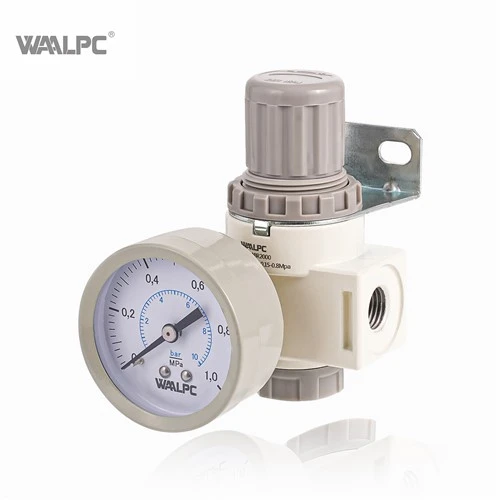
Next up, after the filter, comes the Regulator. This is the part that controls the air pressure going to your tools, because compressors pump out way more pressure than most tools need. Let’s be real: if you hook a 90 PSI compressor directly to a tool rated for 50 PSI, you’re going to blow seals, bend shafts, and ruin the tool way faster than you need to. The regulator’s job is to take the incoming air pressure (which fluctuates, by the way—compressors kick on and off, so pressure isn’t steady) and give you a consistent, adjustable output pressure. That’s why it’s called a regulator.
What’s inside a standard regulator? Let’s keep it real, you don’t need a full engineering breakdown, but the key bits are: a pressure adjustment knob (usually on top, easy to turn even with gloves on), a diaphragm, a spring, and a pressure gauge. The gauge is non-negotiable. You need to be able to see exactly what pressure you’re running, not guess. I’ve seen guys set the regulator by ear, and they’re either running too high (wasting energy, ruining tools) or too low (tools don’t work right, slowing down jobs). Standard regulators will adjust from, like, 15 PSI up to 150 PSI, which covers almost every industrial and shop tool out there. Oh, and another thing: good regulators have a lock feature on the adjustment knob, so some knucklehead doesn’t bump it and change the pressure mid-job. Small detail, but it saves a ton of headaches.
Last in the FRL lineup is the Lubricator, sometimes called the air liner or oiler. This is the part that people either overcomplicate or skip entirely, and both are bad. The lubricator’s job is to put a tiny, precise amount of oil into the air stream going to your tools. Pneumatic tools have moving parts—bearings, gears, pistons—that rub together. If there’s no lubrication, they’ll seize up, wear out super fast, and you’re buying new tools every year instead of every 5. The key here is “precise amount”—too much oil, and it’ll get on whatever you’re working on (like paint for a spray gun, or food in a processing line), too little and tools die.
What’s in a standard lubricator? First, the oil reservoir, usually a metal or polycarbonate bowl, again with a sight glass so you can see how much oil is left. No one wants to run out of oil mid-job and ruin a $300 sander. Then there’s the metering screw—this is how you adjust how much oil gets injected. It’s a tiny screw, but it lets you dial it in for different tools: a heavy-duty impact wrench needs more oil than a small drill, for example. Some lubricators also have an anti-drain valve, so when the system shuts off, oil doesn’t just leak out into the bowl when it’s not running. That’s a big one for guys who leave their FRL unit sitting over the weekend—no oil wasted, no mess.
Wait, hold on—sometimes you’ll see FRL units that don’t have all three parts, right? Filter + Regulator, or just Filter + Regulator + Lubricator but in a different order. But a STANDARD FRL unit is always Filter first, then Regulator, then Lubricator. Why that order? Let me explain: the filter comes first so it catches all the crud before it gets to the regulator and lubricator. If you put the regulator first, all that gunk would clog the regulator’s internal parts, making it leak or stop working. Same with the lubricator—you don’t want oil and crud going through the regulator, that will ruin it fast. The order is non-negotiable for a standard setup. I’ve had customers ask to flip it, and I always explain why that’s a bad call. They usually come back a month later complaining their regulator is broken, and we have to replace it. Lesson learned.
Now, wait a second—are there any extra parts that are part of a standard FRL setup, not just the three main bits? Yeah, the mounting hardware. Most standard units come with a bracket to mount them to a wall or a machine, and pipe adapters to connect it to your air lines. The size of the adapters matters too—standard FRLs come in 1/4”, 3/8”, and 1/2” NPT sizes, which fit most common shop air lines. You want to make sure the FRL’s port size matches your line, otherwise you’ll have leaks that waste air and money. Also, some have pressure relief valves, which are a safety thing—if the regulator fails and pressure gets too high, the relief valve opens to let excess air out, so your lines don’t burst. That’s a key safety component I don’t see enough people talk about.
Let me give you a quick example of why each part matters, from our experience. Last month, a guy brought in his 10-year-old FRL unit, said his impact wrench was dying. We checked it: the bowl was full of water, the filter element was so clogged you couldn’t see through it, and the lubricator was cranked all the way open, dumping way too much oil into the line. He’d been draining the bowl once a month instead of weekly, didn’t replace the filter in 8 years, and cranked the oil because his old tools ran hot. We swapped out the filter, cleaned the regulator, adjusted the lubricator, and his tool ran like new again. Total fix cost him like $70, instead of buying a new $200 impact wrench. That’s the value of a properly working FRL unit—you’re not just buying parts, you’re saving money on equipment downtime and replacements.
Another thing I get asked a lot: “Can I just use a cheap FRL off Amazon instead of yours?” Look, we’re not here to bash other brands, but a lot of no-name FRLs cut corners. Their filter elements are low-grade, so they don’t catch tiny crud. Their regulators leak after a few months. Their lubricators don’t meter oil right, so you’re wasting oil or ruining tools. A standard FRL unit from a reputable supplier (like us) is built to handle consistent pressure, easy to maintain, and lasts for years. We test every unit before it leaves our shop, so you don’t get a dud. That’s worth the extra cash, in my book.
Wait, let’s recap to make sure we didn’t miss any standard components. A standard FRL unit is a three-stage system, in this order:
- Air Filter: Catches moisture, oil residue, and solid particulates. Components here include the pleated filter element, clear bowl with drain, and safety guard.
- Pressure Regulator: Maintains consistent, adjustable output pressure. Key bits: adjustment knob, diaphragm, spring, pressure gauge, lock feature, and optional pressure relief valve for safety.
- Air Lubricator: Delivers precise amounts of oil to tooling. Parts: oil reservoir with sight glass, metering screw, anti-drain valve, and fill cap.
Plus, standard mounting brackets, pipe adapters, and seals to connect it all to your air lines. That’s the full package. No extra fancy parts, just the stuff you need to keep your air system running right.
Now, why does this matter for your business? If you’re in a shop or factory, downtime is money. If your air system is down because of a bad FRL unit, you’re not making product, you’re not paying employees, you’re losing customers. A standard FRL unit is a small investment that prevents big problems. I’ve seen FRL units pay for themselves in a week when they prevent a tool breakdown that would’ve taken three days to fix.
And let’s be honest, it’s not just industrial use. If you’re a guy who works on cars in his garage, or a hobbyist who has pneumatic tools for woodworking, a FRL unit for your small compressor is a game-changer. It’ll keep your $50 air nailer from rusting, keep your pressure consistent so your paint jobs turn out smooth, no runs or splatters. We sell a lot of small FRL kits for home users too—they’re not just for big factories.
So, the next time you’re setting up or replacing an FRL unit, make sure you’re getting all the standard components, in the right order, from a supplier you can trust. Don’t skip the filter, don’t skip the regulator, and don’t skip the lubricator. Each part does a job that none of the others can do, and together they’re the backbone of your compressed air system.
If you’re in the market for a standard FRL unit, or you have questions about sizing, maintenance, or which setup works best for your tools, hit us up. We’re here to help you pick the right unit, no pressure, no jargon, just straight answers. Don’t wait for a breakdown to realize your FRL unit was the weak link—get it right the first time.
Pneumatic Filter References:
- compressedairbestpractices.com. "The Basics of FRL Units for Compressed Air Systems."
- Parker Hannifin. "Pneumatic FRL Components: A Comprehensive Guide for Industrial Applications."
- Fluid Power Journal. "Maintaining FRL Systems to Extend Pneumatic Tool Lifespan."
- SMC Corporation. "Standard FRL Unit Design and Functional Components for Compressed Air."
- Machinery Lubrication Magazine. "Why FRL Lubricators Are Critical for Pneumatic Equipment Reliability.
Hangzhou Evershine Pneumatic Import & Export Co., Ltd.
Hangzhou Evershine Pneumatic Import & Export Co., Ltd. is one of the most professional frl units manufacturers and suppliers in China, featured by high quality pneumatic components. Please rest assured to wholesale bulk durable frl units from our factory. Welcome to contact us for custom service and OEM service.
Address: Hengkun Smart Industrial Park, No.176, Golf Road, Yinhu Street, Fuyang District, Hangzhou City, Zhejiang Province, China 311400
E-mail: Felix@waalpc.com
WebSite: https://www.evspneu.com/
